Stoichiometry is the bookkeeping of chemical reactions: how much of one substance reacts with how much of another. In solution, the link between the volume you measure and the moles the equation needs is molarity. Combine the two and you can answer almost any quantitative solution problem with one consistent method.
Moles are the bridge
Balanced equations speak in moles, not grams or millilitres. The universal strategy is therefore: convert what you are given into moles, use the equation's coefficients to find moles of what you want, then convert back to the units the question asks for. Molarity handles the solution conversions at both ends.
Titration example
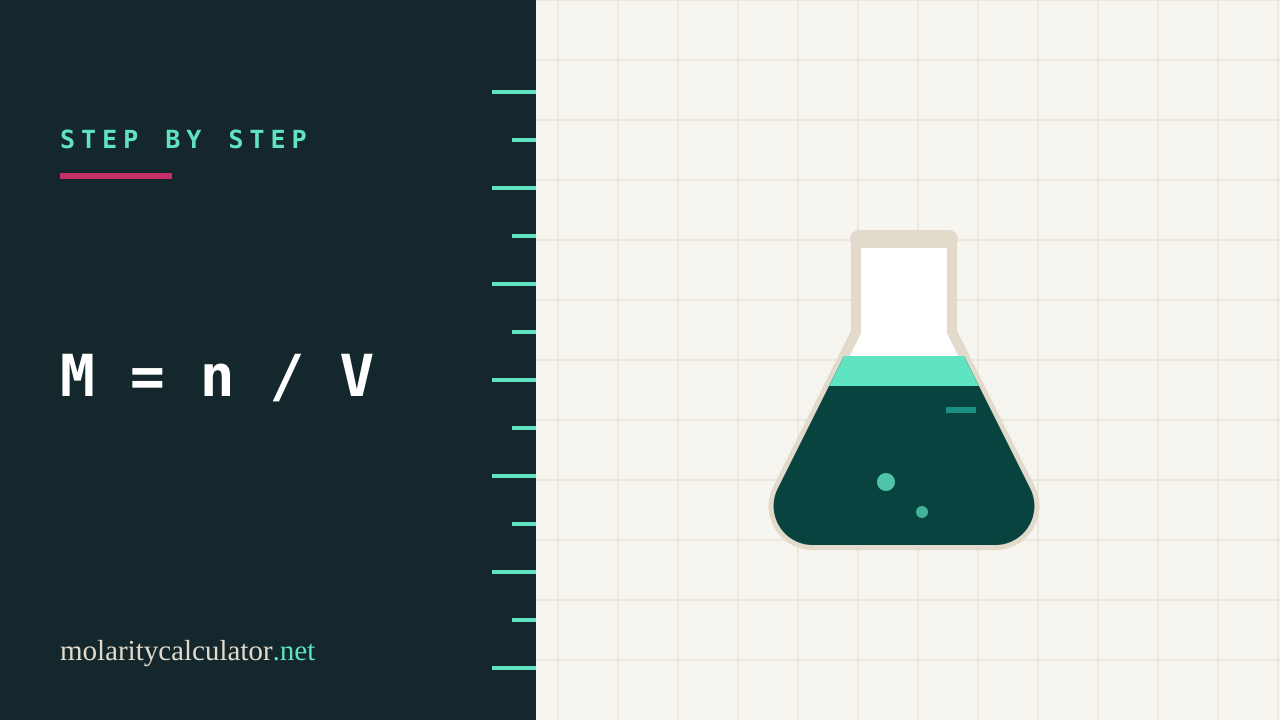
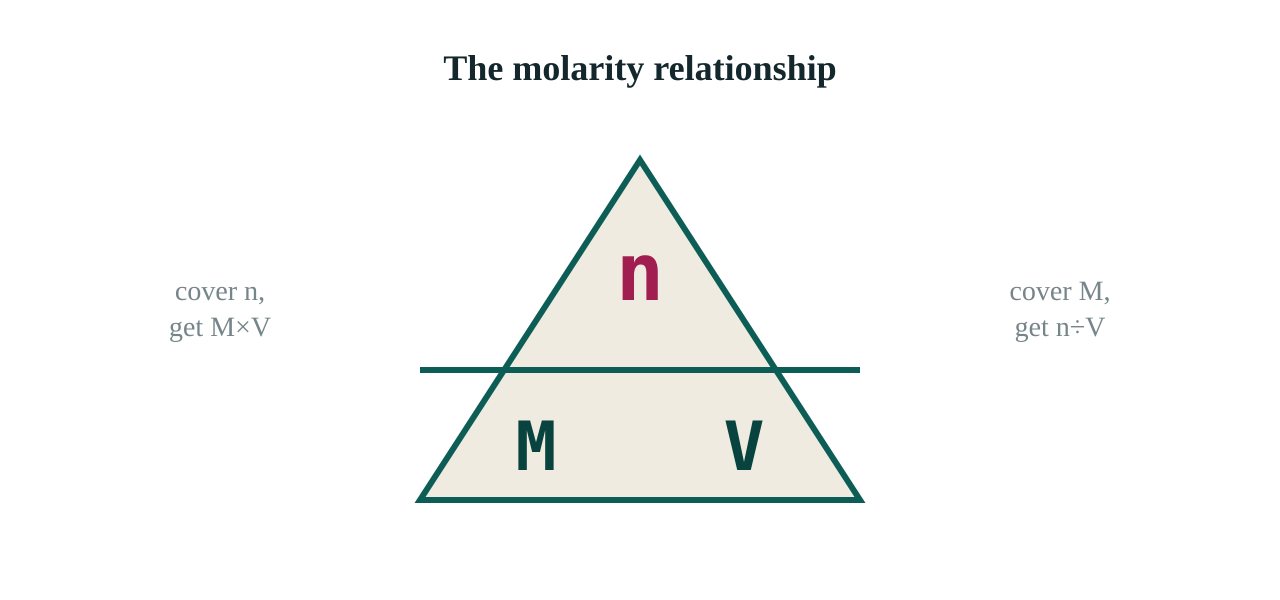
How many millilitres of 0.100 M NaOH neutralise 25.0 mL of 0.150 M HCl? The reaction is one-to-one: HCl + NaOH → NaCl + H2O. Moles of HCl = 0.150 × 0.0250 = 0.00375 mol. The one-to-one ratio means 0.00375 mol NaOH is needed. Volume = n ÷ M = 0.00375 ÷ 0.100 = 0.0375 L = 37.5 mL.
Reactions that are not one-to-one
When coefficients differ, the mole ratio does the work. For 2 HCl + Ca(OH)2 → CaCl2 + 2 H2O, every mole of calcium hydroxide consumes two moles of acid. Find moles of one species, multiply or divide by the ratio from the balanced equation, then convert. Skipping the ratio is the commonest error in solution stoichiometry.
Always balance the equation before touching numbers. The coefficients are the mole ratios — without them the conversions are meaningless.
Limiting reagent in solution
When two solutions are mixed, one reactant usually runs out first. Convert both to moles, divide each by its coefficient, and the smaller value identifies the limiting reagent — the one that caps the product. The other reactant is in excess and some remains unreacted. Yields and final concentrations are calculated from the limiting reagent.
Precipitation and final concentrations
For precipitation reactions, the same method gives the mass of solid formed: moles of precipitate from the limiting reagent, multiplied by its molar mass. To find the concentration of an ion left in solution, divide its remaining moles by the total combined volume of the mixed solutions, not the original volume of one.
The workflow, every time
- Write and balance the equation.
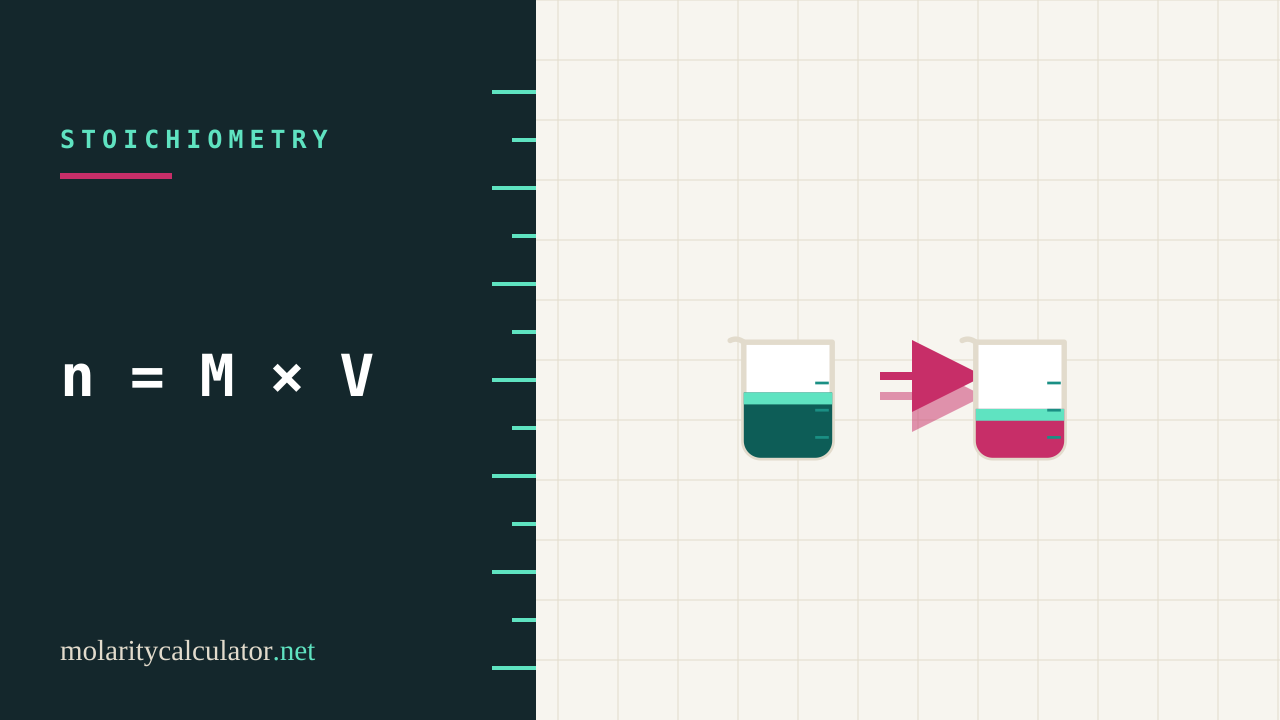
- Convert givens to moles with n = M × V (or mass ÷ MW).
- Apply the mole ratio from the coefficients.
- Convert the result to the requested units.
Run each conversion through the molarity calculator to keep unit errors out of multi-step problems.
Recommended lab gear
Some links below are affiliate links. As an Amazon Associate we earn from qualifying purchases, at no extra cost to you. See our affiliate disclosure.