Solution chemistry, solved
Molarity, worked out properly.
Calculate molarity, the exact mass to weigh, dilutions and molar mass — every answer shown with the full formula and substituted numbers, not just a result. Free, and built for the bench.
Tip: enter a formula above to auto-calculate the molar mass, then fill any two of molarity, volume, or mass.
Enter any three of C₁, V₁, C₂, V₂ and the fourth is solved using C₁V₁ = C₂V₂.
Supports parentheses and hydrates (use a dot or period, e.g. CuSO4.5H2O).
More tools
Three calculators, one consistent method
Each tool rearranges the same core relationships and explains every step, so you learn the chemistry as you go.
Molarity Calculator
Solve for molarity, mass, moles, or volume from a formula or molar mass.
Open tool →Dilution Calculator
Use C₁V₁ = C₂V₂ to find any unknown when diluting a stock solution.
Open tool →Molar Mass Calculator
Get molecular weight from any formula, including parentheses and hydrates.
Open tool →Learn
In-depth guides
Clear, original explanations of the concepts behind every calculation.
What Is Molarity? A Complete Guide to Molar Concentration
Molarity (mol/L) is the most widely used way to express the concentration of a solution. Learn t…
Read guide →
How to Calculate Molarity: A Step-by-Step Method
A reliable, repeatable method for calculating molarity from mass, moles, or volume, with worked …
Read guide →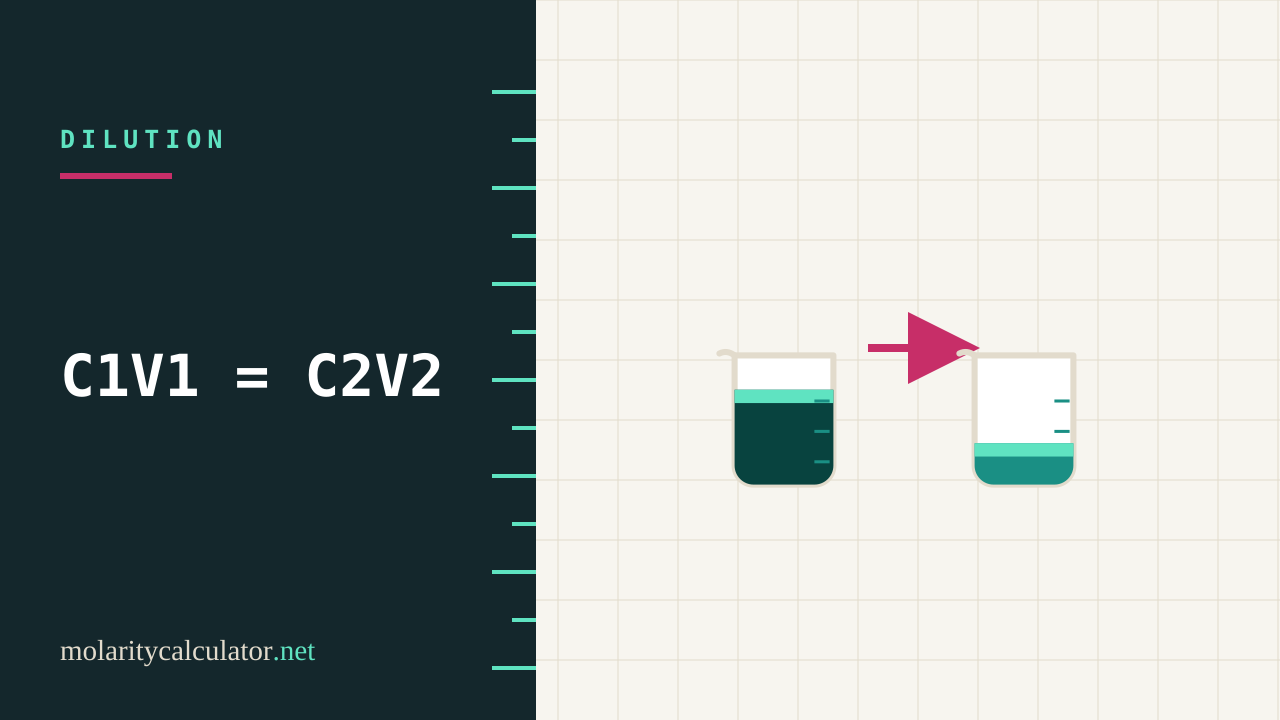
Dilution and Serial Dilution Explained (C1V1 = C2V2)
How to dilute a stock solution to a target concentration using C1V1 = C2V2, plus how serial dilu…
Read guide →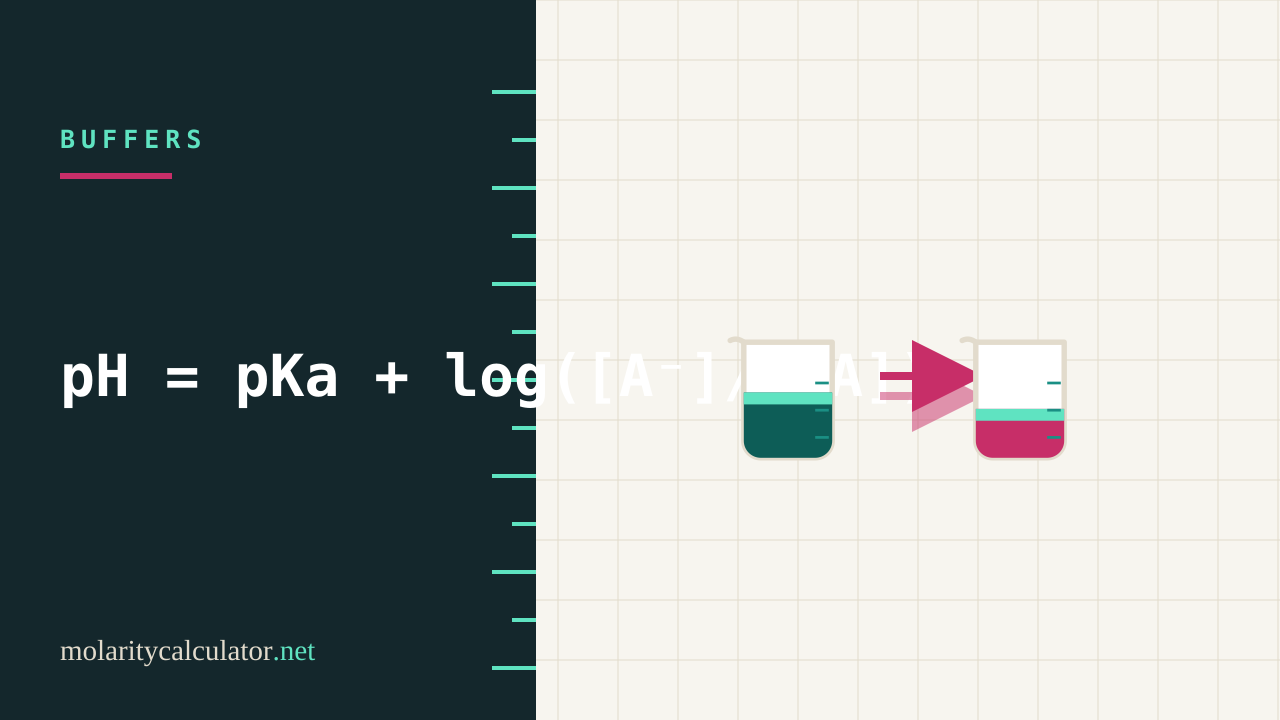
How to Make a Buffer Solution: A Bench Scientist's Guide
Buffers hold pH steady so experiments stay reproducible. Learn how buffers work, how to choose o…
Read guide →
Molar Mass and Molecular Weight: How to Calculate Them
Molar mass is the bridge between grams and moles. Learn how to calculate it from a chemical form…
Read guide →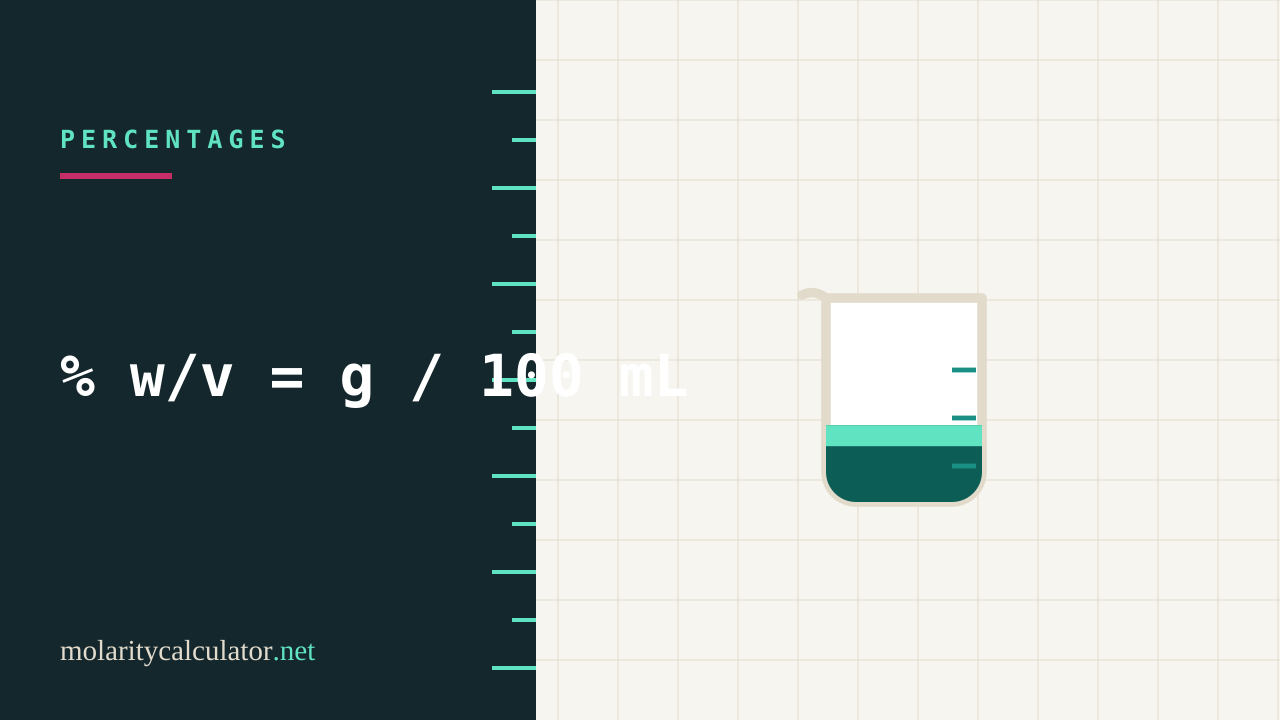
Percent Concentration Solutions: w/v, v/v and w/w Explained
Percentage concentrations are everywhere in labs and product labels. Learn the difference betwee…
Read guide →Make it at the bench
Scalable lab recipes
Standard reagent recipes that rescale to any final volume you enter.
1 M Tris-HCl Buffer
Prepare a 1 M Tris-HCl buffer stock at your chosen pH (7.4, 7.6, or 8.0). The amount of HCl …
Get recipe →
1× PBS (Phosphate-Buffered Saline)
Standard 1× phosphate-buffered saline at pH 7.4 for washing cells, diluting samples, and gen…
Get recipe →
0.5 M EDTA (pH 8.0)
How to prepare a 0.5 M EDTA stock at pH 8.0 — the chelating workhorse behind TAE, TBE, and T…
Get recipe →
50× TAE Buffer
Make a 50× TAE (Tris-acetate-EDTA) stock for agarose gel electrophoresis, then dilute to 1× …
Get recipe →Why use this molarity calculator?
A good calculator should make you faster and more confident. This one shows the substituted formula behind every answer, so you can see exactly where a number came from and catch the classic millilitre-versus-litre slip before it bites. The molar-mass engine reads real chemical formulas — brackets, nested groups, and water of crystallisation included — so you never have to look up a molecular weight separately. And because everything runs in your browser, your inputs never leave your device.
Whether you are checking homework, preparing a buffer, or standardising a titrant, start with the calculator above and dive into the guides when you want the why behind the what.